๐Ÿ“Š INSTRUMENTATION & MEASUREMENT

Optical Signal
Conditioning System

Multi-stage analog signal processing system for optical communications. Utilizes dual-LDR differential sensing, instrumentation amplifier, cascaded bandpass filters, and output buffering to recover clean signals from noisy environments across 5Hz-200Hz bandwidth.

5-200Hz
Bandwidth
5 Stages
Signal Chain
Dual LDR
Noise Rejection
Project Type Academic Coursework
Unit ELEC7008
Institution Western Sydney University
Student ID 22122327
Status โœ“ Complete

01 Project Overview

๐Ÿ”ฌ

The Challenge

Optical communication systems face significant noise challenges from ambient light interference. This project demonstrates advanced signal conditioning techniques to extract a weak LED-modulated signal from a noisy environment using differential sensing and multi-stage filtering.

โš™๏ธ

The Solution

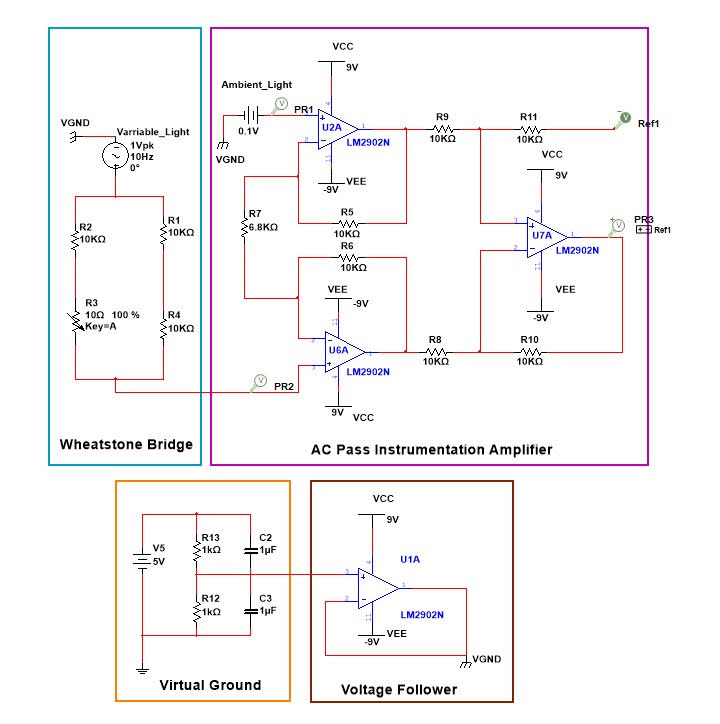
A dual-LDR configuration captures both signal+noise (A0) and noise-only (A1). A differential amplifier subtracts A1 from A0, eliminating common-mode interference. Cascaded active and passive bandpass filters then isolate the 5Hz-200Hz target frequency while rejecting out-of-band noise.

๐Ÿ“ˆ

Course Context

Part of ELEC7008 Instrumentation & Measurement at Western Sydney University. Applies fundamental concepts in sensor interfacing, noise rejection, op-amp circuits, active/passive filters, and signal chain design for real-world measurement systems.

02 Signal Processing Chain

01 - Signal Source
Labradog Signal Generator LED Modulation Optical Transmission
โ†“ Light Beam โ†“
02 - Dual Sensor Array
LDR A0: Signal + Noise LDR A1: Noise Only Wheatstone Bridge
โ†“ Analog Sensing โ†“
03 - Differential Amplifier
Common-Mode Rejection Instrumentation Amp LM2902N Op-Amp
โ†“ Noise Cancelled โ†“
04 - Active Bandpass Filter (A2)
5Hz - 200Hz Passband Non-Inverting Configuration Controlled Gain
โ†“ Filtered Signal โ†“
05 - Passive BPF + Buffer (A3)
Secondary Filtering Output Buffer Clean Signal Recovery
โ†“ Output โ†“
Arduino UNO Data Acquisition
A0: Raw Signal A2: After Active BPF A3: Final Output

03 Circuit Stages & Components

Stage 1
โœ“ Sensors

Wheatstone Bridge & Dual LDR Array

LDR A0 Signal + Noise
LDR A1 Noise Only (Reference)
Configuration Wheatstone Bridge
Resistors R1-R4 (10kฮฉ balancing)
Purpose Differential Sensing
โœ“ Balanced bridge configuration
โœ“ Common-mode noise capture
โœ“ Differential signal extraction
Stage 2
โœ“ Noise Rejection

AC Pass Instrumentation Amplifier

IC LM2902N Quad Op-Amp
Type Differential Amplifier
Function Common-Mode Rejection
Inputs PR1, PR2 from Bridge
Coupling AC Coupled (0.1ยตF)
โ†’ Ambient light cancellation
โ†’ High CMRR performance
โ†’ Signal extraction from noise
Stage 3
โœ“ Active Filter

Active Non-Inverting Bandpass Filter (A2)

Topology Active BPF
Passband 5Hz - 200Hz
Gain Controlled Amplification
Components R8, R9, R10 + Caps
Op-Amp LM2902N (U1A)
โ†’ Selective frequency passing
โ†’ Out-of-band rejection
โ†’ Signal amplification
Stage 4
โœ“ Output

Passive BPF + Output Buffer (A3)

Stage 1 Passive Bandpass Filter
Stage 2 Unity-Gain Buffer
Purpose Final Noise Removal
Buffer Type Voltage Follower
Output Clean Recovered Signal
โ†’ Secondary filtering
โ†’ Low output impedance
โ†’ Load isolation
Support
โœ“ Biasing

Virtual Ground & Voltage Follower

Purpose Single-Supply Operation
Configuration R12/R13 Divider + Buffer
Components 1kฮฉ + 1ยตF Caps
Output Vcc/2 Reference
Function AC Signal Biasing
โ†’ 9V single-supply design
โ†’ AC coupling support
โ†’ Stable bias point

04 Design & Implementation

05 Technical Achievements

01

Noise Rejection

Successfully implemented differential amplifier architecture to cancel common-mode ambient light interference. The dual-LDR configuration captures noise separately and subtracts it from the signal path, dramatically improving signal-to-noise ratio in the presence of strong environmental interference.

02

Multi-Stage Filtering

Designed and tuned cascaded bandpass filter stages (active โ†’ passive) to isolate 5Hz-200Hz target frequency band. The combination of active filtering for gain control and passive filtering for final cleanup provides superior out-of-band rejection while maintaining signal integrity.

03

Complete Signal Chain

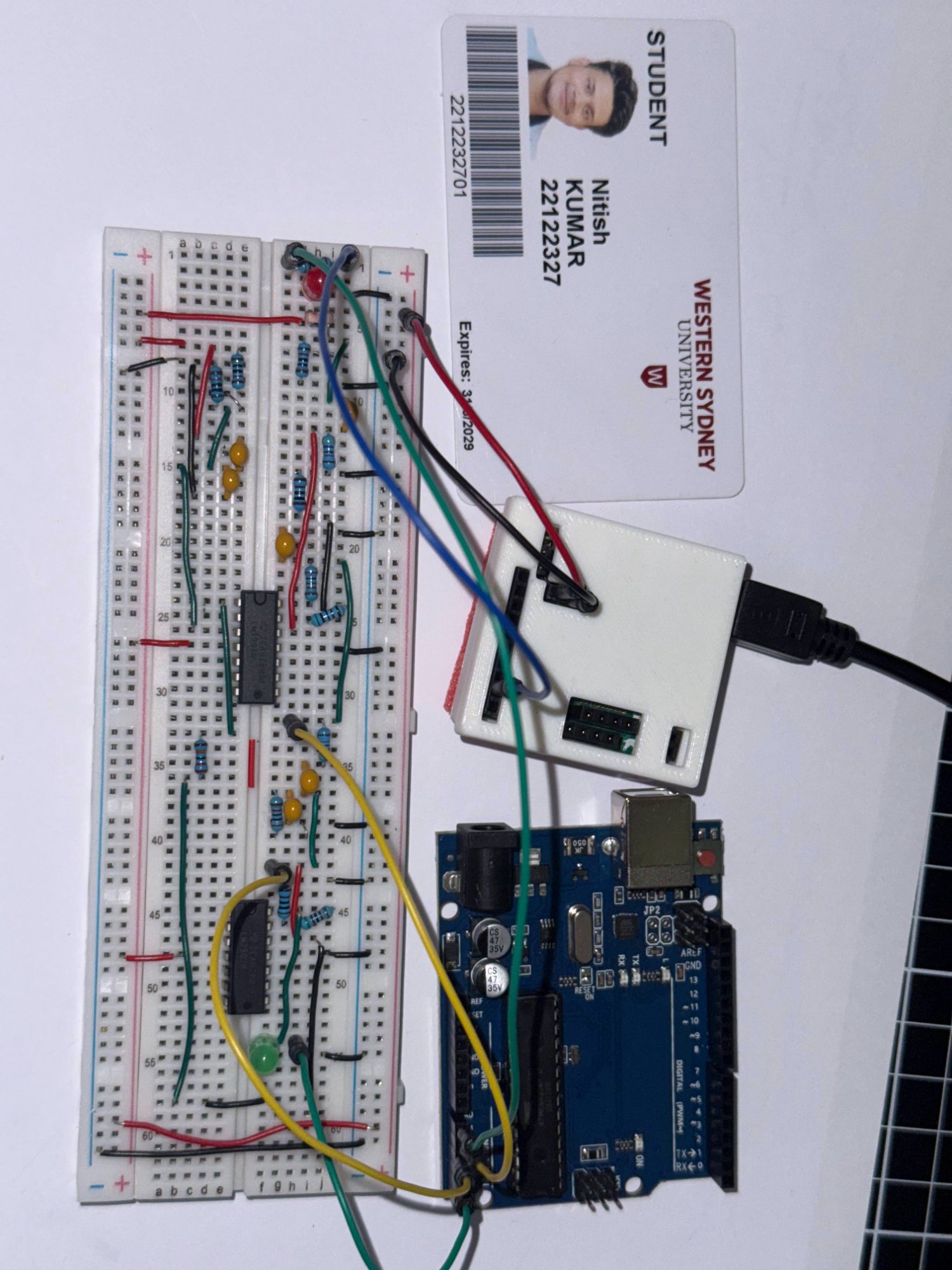
Integrated all stages from sensor interfacing through signal conditioning to buffered output. Arduino UNO data acquisition at multiple test points (A0, A2, A3) validates progressive signal improvement through each processing stage, confirming successful recovery of the clean signal.

06 System Specifications

๐Ÿ“Š

Signal Parameters

Frequency Range: 5Hz - 200Hz
Signal Source: LED (Labradog modulated)
Sensors: Dual LDR array
Coupling: AC coupled
Supply: ยฑ9V (single supply with virtual ground)

๐Ÿ”ง

Key Components

Op-Amps: LM2902N (Quad)
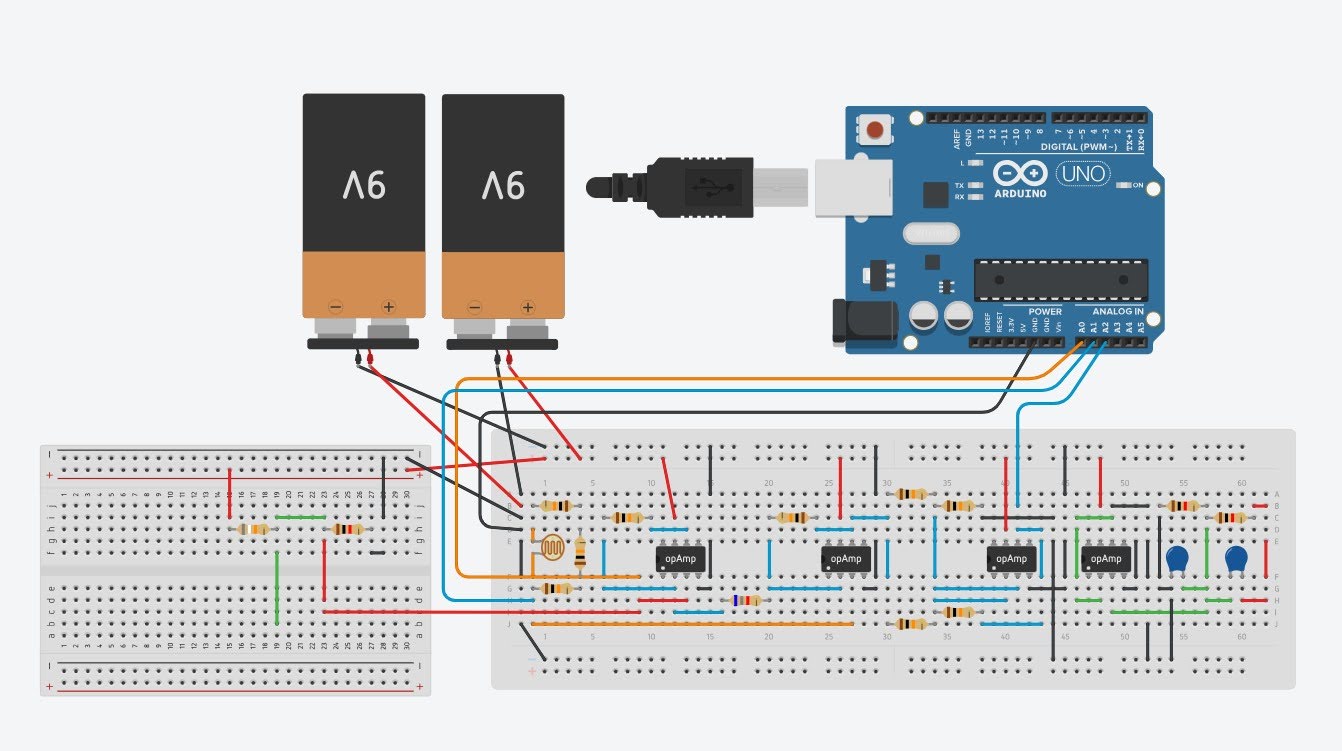
Sensors: 2ร— LDR photoresistors
MCU: Arduino UNO
Power: 2ร— 9V batteries
Passive: Resistors, capacitors, LEDs

โš™๏ธ

Design Features

Topology: Multi-stage signal chain
Noise Rejection: Differential amplifier
Filtering: Active + Passive BPF
Output: Unity-gain buffer
Testing: Arduino multi-point acquisition